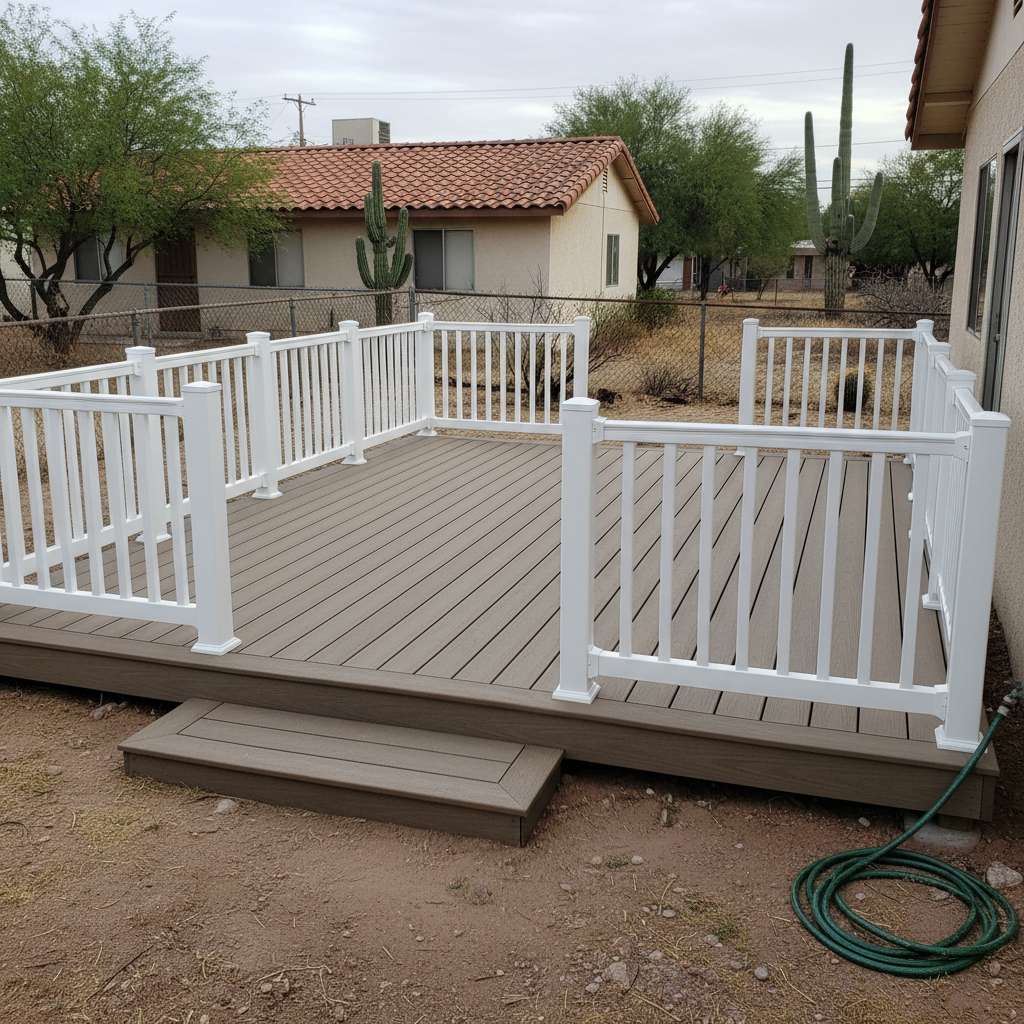
A deck is one of the few home improvements where the builder's shortcuts don't show up for a year or two, and by then they've cashed the check and moved on. In Goodyear, the ground and the sun both make that worse. Here's what actually separates a contractor worth hiring from one you'll be calling back in eighteen months.
Start with the license, not the sales pitch
Arizona requires a contractor's license for residential structures over a certain value, and a deck almost always crosses that line once you add footings, framing, and railing. Ask for the license number and look it up with the Arizona Registrar of Contractors yourself, it takes two minutes. Ask for proof of general liability insurance and workers' comp. If someone falls off a ladder on your property and the crew isn't covered, that liability can land on you as the homeowner. A legitimate builder hands this information over without making you ask twice.
Anyone who quotes you a number and says they'll "skip the permit to save time" is telling you something important about how they build, not just how they bill.
What the ground here actually does to a footing
Goodyear sits on old farmland, cotton and alfalfa fields mostly, filled in and graded flat for the subdivisions that went up from the 1990s on through communities like Estrella and PebbleCreek. Under a lot of those lots you'll hit caliche, a hardpan layer of cemented calcium carbonate that can start a few inches down or several feet down depending on the block. Caliche doesn't dig like dirt. It breaks a post hole digger and it'll wear out a cheap auger bit in an afternoon. A builder who's worked here knows to probe before they quote and to price for breaking through it, not to show up with hand tools and discover the problem on day one.
The upside is you don't have a frost line to worry about the way builders do in colder states. Footing depth in Goodyear is driven by soil bearing capacity and local code minimums, not frost heave. But caliche can also perch water above it instead of letting it drain, so a footing poured in a low spot without a few inches of gravel underneath can sit in standing water after a monsoon storm. Ask how deep they're going and what's under the concrete, not just what diameter the hole is.
Permits, inspections, and why the city cares about your ledger board
The City of Goodyear issues the building permit for deck construction, and for anything attached to the house, elevated, or over a certain size, you need one. Expect at least two inspections: one after the footings are dug and before concrete goes in, and a final inspection once framing and railing are complete. If your home has a stucco exterior, which most houses built here do, the ledger board can't just be screwed through the stucco into the sheathing. It needs the stucco cut back, proper flashing installed, and lag bolts or through-bolts into the actual rim joist or blocking behind the wall. A deck that pulls away from the house in a windstorm almost always traces back to a ledger that was never really attached to structural lumber in the first place.
Most newer communities in Goodyear also have an HOA, and the HOA's architectural approval is separate from the city permit. A builder who's done work in Estrella or Canterra before knows this and builds the timeline for it into your schedule. One who's never dealt with an HOA submission will find out when your project stalls for three weeks waiting on paperwork nobody warned you about.
Materials that can actually take a Goodyear summer
June through August here regularly tops 110 degrees, and a dark composite board can hit surface temperatures well past that in direct sun, enough to burn bare feet. Composite decking holds up better than wood against our UV exposure and doesn't crack or splinter the way pressure-treated pine will after a few dry seasons, but it still gets hot, and lighter colors handle it better than dark ones. If a builder tells you composite is maintenance-free, ask them what happens to the fasteners. Standard steel screws corrode faster here than people expect because of the heat cycling, and the wrong hidden-fastener clip can work loose within a couple of years. Stainless or coated fasteners cost more and are worth it.
Real wood, cedar especially, needs an oil-based sealant reapplied close to every year in this climate, not every three like you'd hear in a milder state. The arid heat pulls moisture out of the board fast and it checks and splits if it's left bare even one summer. Monsoon season, July through September, brings sudden downpours and wind gusts that can hit 50 miles an hour, so any pergola or shade structure needs to be engineered for wind load, not just built to look sturdy on a calm day.
Railings, spans, and the things an inspector will actually fail
Guardrail height in residential code is a minimum of 36 inches, and the gaps in the railing can't let a 4-inch sphere pass through, which rules out a lot of the wide-spaced cable or horizontal designs homeowners see in photos online. Joist spans have to match the board thickness and species, which is why a contractor should be telling you joist spacing before you pick decking color. These are the details a city inspector checks and a homeowner usually can't see once the boards are down. If a builder can't answer a basic question about span tables or fastener spacing without checking a chart on their phone, that's not disqualifying by itself, but it's worth noticing.
The contract and the walk-away signs
A real quote breaks out materials, labor, permit fees, and a rough timeline, and it names the decking brand and railing system, not just "composite decking, qty 1." Get the payment schedule in writing. A deposit is normal, being asked for more than half up front before any work starts is not. Walk away from anyone who won't put the scope in writing, who can't produce a license number, or who tells you permits are a waste of money for a deck. Those three things together describe most of the deck horror stories homeowners post online, long before anyone mentions the actual carpentry.
We build and repair decks around Goodyear and the surrounding towns, from ground-level platforms to multi-level decks on sloped backyards, and we deal with this ground and this heat on every job. If you want a straight answer on footings, materials, or what your project actually needs before you sign anything, take a look at Ironwood Deck Company.